The Maltonian Web
ARCHIVE PAGE: this website is gradually being updated from May 2022
Yorkshire Life 1963 - page 2
 Page 2
In the nineteenth century, in common with other school of its kind, Malton found itself short of money. In an attempt to revive its fortunes, a new master removed it in 1835 to Norton on the opposite bank of the river. It then became a private school, but though Malton boys were admitted at a reduced rate and Classics were still taught free, in accordance with the statutes of the school, there was a good deal of opposition to the move and thirty years later, when another master was appointed, it returned to its original site.
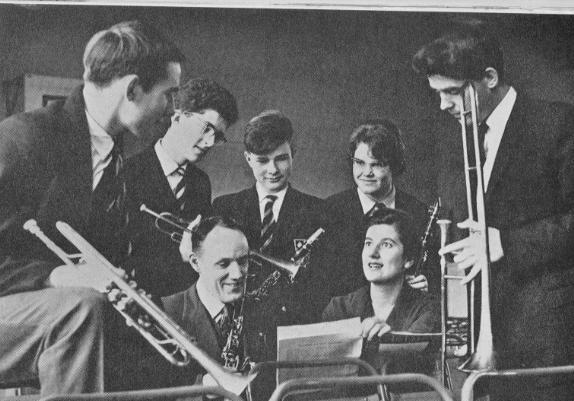
The orchestra
A number of local people promised to help provide new buildings and furnishings, but the plans came to naught; the school continued to decline. At the turn of the century few pupils were left, and when the headmaster died in 1904, the school for a time died with him.
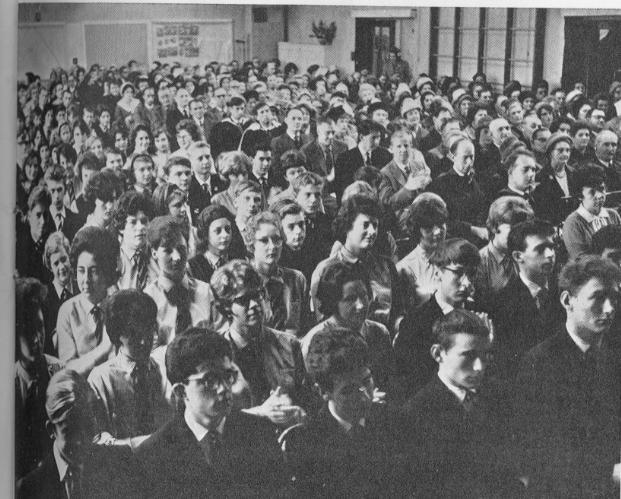 Speech day audience
But Malton's pride in it lived on. A body of local men, headed by Mr William Copperthwaite, began to press for its revival. Their courage and perseverance were eventually rewarded, and in 1911 the school was re-opened, this time at New Malton.
The direct descendant of the Archbishop Holgate foundation, it was, nevertheless, very different from it in one important respect. At a time when most schools catered for girls or boys, the new school was planned for both.
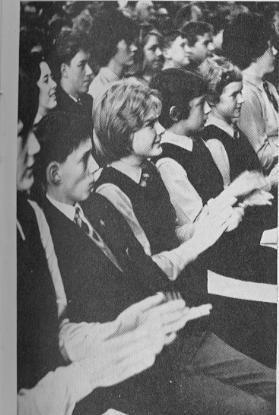 Speech day
From that time, co-education has been a vital feature of Malton Grammar School, and the present headmaster, Mr P T Taylor, M. A. no less than his predecessors, strongly supports it.
The new site in Middlecave Road was ideal, an integral part of the town yet on the outskirts of it, an open site which even today looks over miles of open country to the distant moors.
The buildings of 1911 very soon became inadequate, but the first extensions of 1937 the school acquired a full range of specialist rooms. Further buildings were added in 1954 and 1959.