
The Maltonian Website - for Malton School
Maltonians document archive - John Estill Solicitor's Papers
Remarks on Sutton Grange
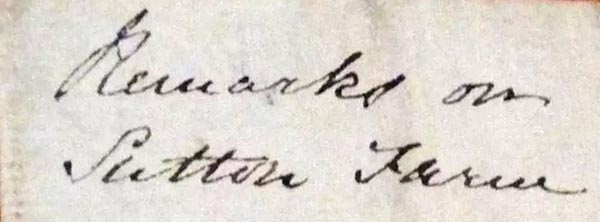
Notes on Sutton Grange, I think written by William Pound. Sutton Grange was an area of farm land and buildings in Langton, Norton, which formed part of the original endowment of lands. A Grange was an outlying farm with buildings belonging to a monastery - Sutton Grange formed part of the lands on St Mary's Gilbertine Priory, and formed part of the purchase by Robert Holgate on the dissolution of the Priory.
William Pound moved the Free Grammar School from Old Malton to Sutton Grange in 1835, and changed its function to widen the curriculum beyond the "dead languages", also charging fees for access to this wider curriculum. This was not a popular move in some quarters - this letter appears to be defending his move against a recent petition from Old Malton parishioners. White's trade directory of 1840 states: The Archbishop of York appoints the master, and that office is now held by the Rev. Wm. Pound, who has improperly perverted the school premises to other uses, and since 1835, has conducted the school in a building adjoining his residence, in Norton parish; and he now allows £20 a year to the master of the National School, which was build in Old Malton, in 1836, by subscription. I believe this is the building which became the infants school on Town Street.


Remarks on Sutton House
Archbishop Holgate in the year 1656 [sic] founded the free Grammar School of Old Malton, and constituted the Master, a free and independent corporation and gave hime the sole possession and right of the lands of endowment, subject to the condition that the lands should not be let in longer leases, than 12 years, excepting to the relatives of the Founder, and to them, for 21 years at most. He provided also: that the Master should, on no account alienate the lands, or let them for longer periods. In the year 1769 when the inclosure of the Township of Sutton was made, the lands called the Sutton Grange Farm, were held under an unexpired lease for 12 years; part of the School lands, included in this lease, being at that time enclosed and part not.
In the Act of Enclosure 1773 It created a law that enabled enclosure of land, at the same time removing the right of commoners' access it was enacted that an allotment should be made to the School master in common with the other owners of land in the Township, and further, that the Fee simple of the lands, should be consigned over to the tenant, then in possession of the unexpired lease, under condition of a fixed yearly payment, that payment being "a full(?) and adequate satisfaction and compensation, as well for the present yearly rent, as for all fines &c, which might have been claimed, in case this act had not been made" The commissioners award £32.6.0 to be a full and adequate compensation and satisfaction, for all claims, which could have been made upon the lands, in case this Act had not passed. This farm, which consists of upward of 160 Acres, now lets for £317 per Annum.
Now, supposing Parliament, after lapse of years, sees fit to alter the deed of the Founder; and this alteration, turns our to be injurious to the foundation, and contrary to the will of the Founder since it places in the hands of an individual nine-tenths of the revenues of this charity.
Is there no way by which such a mistake can be rectified so as to obtain a more just and equitable payment out of these lands, especially as it appears that the holder of the simple had no further right to the lands in the year 1769, than a lease of 2 years, would entitle him?
Cannot a new commission be appointed to enquire whether the land be disposed of according to the deed of the Founder, and whether the present payment of the tenth of the real value, be in accordance with the intent of the Act of Enclosure?
And if no commission can be issued for that purpose, cannot Parliament by a new Act, amend and correct a former Act, which had not worked fairly and justly, to the parishes concerned; but had benefited one individual subject of the realm and by injuring a Charity, had evilly affected a large community.
Links: Malton School | Malton Community Sports Centre | Malton and Norton Memories Facebook page | oldfern.co.uk
Copyright © 2013 Steve Fearnley