
The Maltonian Website - for Malton School
Terry Dyson
This page was originally created 24/07/03. Updated 25/6/25
Terry's mum and dad, Jessie and 'Ginger,' ran The Fleece in Malton. His dad had previously been a professional jockey. Terry attended Malton School as a boy from 1946-1952, and went on to play football for Tottenham Hotspur from 1955 to 1965. He made 209 appearances and scored 55 goals. During this time the team won the FA Cup in 1961, with Terry scoring the second of the two goals, as well as doing the doube that year. He missed the 1962 final, when Spurs won again, beating Burnley 3-0, but was in the team again in May 1963 when the team won the European cup, beating Atletico Madrid 5 - 1 in the Feyenoord stadium, and he was on the scoresheet again, scoring two goals.
Below are just two photos from the school archive, pus a friend's photo from Malton and Norton Memories, and an interview with Terry for the Maltonian magazine in 1961. There are many more photos on the internet which I have found, but sadly many of them have copyright issues and have been secured by the likes of Alamy and Getty Images for sale at excessive prices. .
 Malton School 1951
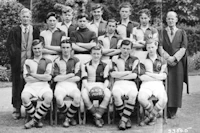 Malton School 1952
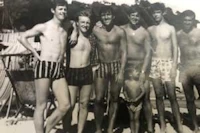 Holiday in Jersey
An interview printed in the July 1961 Maltonian (No. 116)
The editor referred to throughout will have been Mr Lloyd.
INTERVIEW WITH TERRY DYSON
There will be very few schools in the country that can claim among their former pupils a footballer who has won in the same season a Cup Winner's medal and a League Championship medal. We in Malton have taken a special pride in the unique achievements of Tottenham Hotspur because of the regular 'Place held in the side by our own Terry Dyson. Great was our joy indeed as, glued to our television screens, we saw an Old Maltonian give the pass for the goal that put the Spurs in the lead; and then, a little later, come leaping in from the wing to head the splendid goal that put the result beyond all doubt.
When Terry returned to Malton on holiday the editorial staff were quick to seek an interview and the following questions and answers were the outcome.
Editor: Mr. Dyson, may I begin by saying that throughout the last season we at M.G.S. have been following the fortunes of the 'Spurs' with very close attention; and that we were all completely delighted at the splendid performances you achieved. On behalf of all the readers please accept our heartiest congratulations.
Mr. Dyson: Thank you very much.
Editor: Would you begin by outlining your footballing career?
Mr. Dyson: I remember my first game for the School, the last game of the season, when I was in Form I. We drew 0-0. Mr. Rolls took games in those days and I owe a great deal to his coaching and advice. He it was who said I would make an outside-left, though I usually played at inside-left for the School, where I had more of the game. I stayed at school until I was 17, staying two years in the Fifth. In fact I was in the first group to take the new G.c.E. By this time I was playing for Norton. On leaving school, until I went in the Army for National Service, I played for Scarborough. The Army gave me my big chance, for whilst playing for Woolwich I was spotted by a Tottenham scout. In fact, I took over in that Army side from Ron Henry, who moved to left back, where he now plays for Spurs. On leaving the Army I signed for Tottenham and have been with them for six seasons. But it was only this season that I could keep a regular place in the first team, though I'd often played an occasional game.
Editor:Did you despair of winning a first team place?
Mr. Dyson: At times I was impatient and thought of transfer, especially when Spurs bought Cliff Jones. But as Spurs are a fine club to work for I was reluctant to leave.
Editor: How would you describe the Tottenham approach to the game?
Mr. Dyson: We always try to play good football; i.e. that everything we do should be thoughtful and constructive. We try to avoid wild passes. Above all, we think in terms of spaces; a player moves, takes an opponent with him and thus creates a space which can be used by another player. Of course, when near goal, we think rather of shots at goal and will always chance a shot when there's an opportunity, even if it causes a breakdown in attack.
Editor: How does this differ from the approach of other clubs?
Mr. Dyson: Many clubs have the same approach; for instance Manchester United. But others are more direct and robust in attack, such as Wolves and Sheffield Wednesday. Then many clubs have their own pet schemes, such as the deep-lying centre forward plan used by Manchester City.
Editor: Do you have pre-arranged plans for each match and for special kicks, etc?
Mr. Dyson: Certainly. These vary with our opponents. Then there are a number of set moves for free kicks and throws-in. Danny Blanchflower takes the kicks and we are all on our toes to see which of the different tricks he will use.
Editor: Your forwards always seem to be changing position. I noticed you and Cliff Jones swopped positions just after the kick-off at Wembley.
Mr. Dyson: Yes, we do this frequently. When one forward changes position the others automatically switch over to keep the line even across the field. We always try to keep in line, and we all come back in defence, not just the inside men. There is no goal scoring specialist, though of course George Smith got a lot more than anyone else. All the forwards got over double figures this season.
Editor: How many have you scored?
Mr. Dyson: Eighteen.
Editor: Would you call Spurs an attacking side?
Mr. Dyson: Definitely. The wing halves play up-field as much as possible and have scored several goals. Then our centre-half comes up for corners, where his height is very useful.
Editor: Looking back on the last season what was your toughest game?
Mr. Dyson: Probably the Cup tie at Sunderland, which we drew after a very tough match. The Roker Park crowd were a great help to the home side. We were glad when the whistle went.
Editor: There was a tremendous build up for the Cup Final and you had the disadvantage of being favourites. Did this worry you?
Mr. Dyson: Not very much. We tried to take no notice and to think only of the game. But of course our play wasn't at its best.
Editor: Fans will argue about the effect of the injury to a Leicester player for years. But what is your view?
Mr. Dyson: As you say, we can never know. Personally, I don't think it made any difference, but it was certainly very bad luck on Leicester.
Editor: What are your plans for the European Cup?
Mr. Dyson: We feel we have a very fair chance of reaching the quarter-finals. Then we shall be really up against it and shall have to change our tactics, particularly for the away game against clubs like Real Madrid, who are a fine attacking side. We shall have to try a more defensive game than we usually play. But the details haven't been worked out yet, of course.
Editor: You've said quite a bit about tactics. How are they decided?
Mr. Dyson: Well, we all have our say and offer suggestions. Then the manager, Mr. Nicholson, who also does most of the coaching, and Danny Blanchflower, sum up and make the decisions.
Editor: What sort of training programme do you follow?
Mr. Dyson: Nothing very unusual. We train Tuesday to Friday, and Monday as well at the start of the season. There's a fair amount of gymnastic and running, and weight-lifting twice weekly. This season we've had a special building for 5-a-side play, which has helped a lot. They say Spurs are a friendly team, which is true, of course. But you wouldn't think it watching one of these matches. More seriously, we have a number of practice matches with lots of stops to work out new moves.
Editor: Any comments about your colleagues?
Mr. Dyson: They're a lively set of fellows, of course, and we have a lot of fun. Danny Blanchflower is a very popular captain and a great personality.
Editor: What about club feeling generally?
Mr. Dyson: Very friendly. We all pull together. It's amazing how many people are needed to put our three teams on the field. I have a photograph at home showing over 300 people who work for the club: programme sellers, door-keepers, etc. We even have our own band.
Editor: What are your relations with the reserves?
Mr. Dyson: Very good. There's very little jealousy. Medwin, of course, whose place I took in the side, is still a current international. Even a player like Marchi can't keep a regular place in the first team.
Editor: Is the present side often contrasted with the fine Spurs side of the early fifties, the team of Burgess, Ramsey, Ditchburn, Bailey and Duquemine?
Mr. Dyson: Very often. "The Duke" now has a shop near the ground. Most of the others are managers, trainers or coaches.
Editor: Would you agree that Spurs keep a happy balance between training their own Players and buying them from other clubs?
Mr. Dyson: Yes. Six of the present side were transferred for large sums, five were trained by the club.
Editor: You must excuse my mentioning this but Spurs have been criticised in certain quarters for exhibitionism on the field, particularly when goals are scored. Have you any comment?
Mr. Dyson: One gets carried away by the crowd, you know. Anyway, it's all part of the entertainment the crowd are paying for.
Editor: One reads of rows between clubs and directors, at Aston Villa for example. Do you have any trouble in this way?
Mr. Dyson: None at all. The directors leave the running of the club to the Manager.
Editor: What will happen to the large profits the club must have made this season?
Mr. Dyson: Most of the cash will go back into the game. For example, a great deal is being spent on installing new flood-lighting.
Editor: Do you find the job of a professional footballer strenuous?
Mr. Dyson: The season's hard at times, especially at Christmas and Easter. But generally one can lead a normal working day. I am in digs, ten minutes from the ground, and very comfortable. We returned from our Dutch tour last week (mid May) and have to report again on July 21st. The pay is good, especially for members of a successful First Division side.
Editor: What steps should a young man anxious to become a professional footballer take?
Mr. Dyson: In some areas he will be spotted by a scout, often whilst at school. But this is unlikely to happen here. If a lad writes for a trial with a big club he'll usually be given one. Some of the Spurs team say that if a player is good enough he'll make the grade, others reckon that good players are often missed because of a bad trial.
Editor: Any tips for a young player?
Mr. Dyson: Ball control is the vital thing and he should practise this often, giving as much time to it as actual match play.
Editor: Can you name any other Malton players who could have made the grade professionally?
Mr. Dyson: I think Bruce Rolls would have stood a very good chance.
Editor: Who was the best full-back you Played against this season?
Mr. Dyson: Undoubtedly Jimmy Armfield.
Editor: Any comment on the England side?
Mr. Dyson: I should say they're the best for some seasons. They were unlucky to lose against Austria, the result of a badly planned tour. They should do well in the next World Cup.
Editor: May I finish on a somewhat different note? Have you any comment on the refusal by Danny Blanchflower to appear on the B.B.C.'s This is your Life.
Mr. Dyson: We were surprised, of course, because we were all set to go before the cameras. Mr. Nicholson, the manager, came round at lunch-time and asked us to be available, but to say nothing to Danny. I think the general feeling was that it was his affair.
Editor: It would be pointless to ask about your hopes for next season. So on behalf of 'The Maltonian' and all its readers I will simply wish you and all the team the very best of good fortune.
Mr. Dyson: Thank you very much. Will you please send me a copy of the "Maltonian"?
Editor: With the greatest of pleasure.