
The Maltonian Website - for Malton School
Maltonians' lives: Philip Taylor
Malton Grammar School headmaster 1951-1971
1971 Malton Gazette obituary. Memories from Philip's daughters, Rosie and Gillian
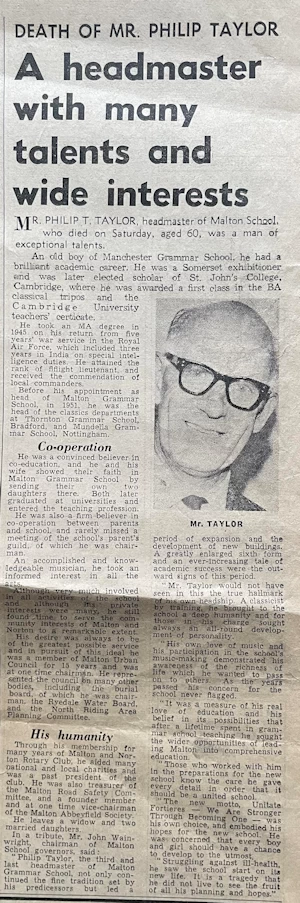
Obituary from the Malton Gazette Friday 22 October 1971
A headmaster with many talents and wide interests
Mr PHILIP TAYLOR, headmaster at Malton School, who died on Saturday, aged 60, was a man of exceptional talents.
An old boy of Manchester Grammar School, he had a brilliant academic career. He was a Somerset exhibitioner and was later elected scholar of St. John’s College, Cambridge, where he was awarded a first class in in the BA classical tripos and the Cambridge University teachers’ certificate. He took an MA degree in 1945 on his return from five years war service in the Royal Air Force, which included three years in India on special intelligence duties. He attained the rank of flight lieutenant, and received the commendation of local commanders.
Before his appointment as head of Malton Grammar School in 1951, he was the head of the classics department at Thornton Grammar School, Bradford, and Mundella Grammar School, Nottingham.
Co-operation
He was a convinced believer in co-education, and he and his wife showed their faith in Malton Grammar School by sending their own two daughters there. Both later graduated at universities and entered the teaching profession.
He was also a firm believer in co-operation between parents and school and rarely missed a meeting of the school’s parent’s guild, of which he was chairman.
An accomplished and knowledgeable musician, he took an informed interest in all the arts.
Although very much involved in all activities of the school and although his private interests were many, he still found time to serve the community interests of Malton and Norton to a remarkable extent.
His desire was always to be of the greatest possible service and in pursuit of this ideal he was a member of Malton Urban Council for 13 years and was at one time chairman. He represented the council on many other bodies, including the burial board, of which he was chairman, the Ryedale Water Board, and the North Riding Area Planning Committee.
His humanity
Through his membership for many years of Malton and Norton Rotary Club he aided many national and local charities and was a past president of the club. He was also treasurer of the Malton Road Safety Committee, and a founder member and at one time vice-chairman of the Malton Abbeyfield Society. He leaves a widow and two married daughters.
In a tribute, Mr John Wainwright, chairman of Malton School governors said:
"Philip Taylor, the third and last headmaster of Malton Grammar School, not only continued the fine tradition set by his predecessors but led a period of expansion and the development of new buildings. A greatly enlarged sixth form and an ever increasing tale of academic success were the outward signs of this period.
"Mr Taylor would not have seen in this the true hallmark of his own headship. A classicist by training, he brought to the school a deep humanity and for those in his charge sought always an all-round development of personality.
"His own love of music and his participation in the school’s music-making demonstrated his awareness of the richness of his life which he wanted to pass on to others As the years passed his concern for the school never flagged.
"It was a measure of his real love of education and his belief in its possibilities that after a lifetime spent in grammar school teaching he sought the wider opportunities of leading Malton into comprehensive education.
"Those who worked with him in the preparations for the new school know the care he gave every detail in order that it should be a united school.
"The new motto, Unitate Fortiores – We Are Stronger Through Becoming One – was his own choice, and embodied his hopes for the new school. He was concerned that every boy and girl should have a chance to develop to the utmost.
"Struggling against ill-health, he saw the school start on its new life. It is a tragedy that he did not live to see the fruit of all his planning and hopes."
A Short Biography of Philip Taylor
submitted by his daughter Rosemary, March 2002 with some additional notes by his other daughter, Gillian.
Updated following some family research by Rosemary, January 2008
He was born 17 June 1911 at Heaton Chapel, Manchester, moving to Middleton Junction as a child to a to a row of houses my grandfather had built for relatives. His father was a textile engineer for Whitehead, Sumner and Harker, working mostly in Spain and Italy setting up cotton mills. I think his father's frequent absence from home shaped his caring nature and willingness to do housework! His mother had been a successful elementary school teacher and, like many women, resented that this had to be given up on marriage, and she hated Middleton. His brother was an architect.
His education was at Manchester Grammar, then Cambridge University - resulting in an MA in Classics. He taught Classics in Bradford where he met my mother, then Nottingham Mundella School before going to Malton as Headmaster.
He was called up to the Air Force in the war - and became a Flight Lieutenant, but never flew in a plane. He was sent to Burma briefly; he volunteered to be code breaker of Japanese messages. Most of the time he was stationed near Delhi, except for an enjoyable spell in Kashmir. He spent much of his time organising musical entertainment for the other troops.
He had two daughters, Gillian and Rosemary. He was on Malton Town Council, was a Rotarian, and a JP.
The school motto he chose summed up his attitude to life - Audi alterem partem. He did not believe in disciplinary school rules, only administrative ones. He thought everyone had a right to their own point of view and should discipline themselves - it worked at MGS, I'm not sure it would now?
His real passion was music. He played the piano whenever he could. He was also a good singer and violinist. He took every opportunity to conduct the school choirs and orchestra (not sure what the music teachers really thought). He seemed to do most of the cover for absent teachers and, if nothing was set and the hall was free, he would take us round the piano to sing the comic songs from Gilbert & Sullivan. Did he do this with other forms?
He had a great sense of humour - I'm not sure this came over to the other pupils. I remember an assembly when he had to read out a new pupil's name, which suddenly struck him as very funny. He announced the subject and then there was a long silence. Everyone but me thought he had been taken ill. I knew he was having a giggling fit and couldn't bring himself to say it.
He did every assembly, every morning for the whole school. He had plans in his retirement to write a book on making assemblies more relevant to older pupils. He always wore his gown - the torn one for every day use. (He had a best one for speech days.) It was always torn because, in the "new" building, the swing doors would close to, trapping the back of it as he swept through.

There was a clock in his office that had a loud tick and then a "clunk" every few minutes. I only remembered this the other day, when we received one in the museum where I work. When I did A level Latin, there were only two of us, so we had lessons in his office. I can remember hot summer afternoons in there with the windows open and the scent of the roses.
My father believed in educating the whole person. In the first year, we had Headmaster's Period when he told us about local government, the law and public transport. In the Sixth Form, he did whatever he felt like: more Gilbert and Sullivan, or poetry (Wilfred Owen, T S Elliot and Houseman), debates (hanging, war, God), music and comedy (romantic symphonies*, jazz, Tom Lehrer, Peter Sellers).
My father.
Some additional memories from Rosemary's sister, Gillian.
In addition to Rosemary's comments about our father, I should like to add that, when he was in the Air Force during the war, he had a nickname - cool, calm and collected, and I never remember him "losing his cool" at school. Only once do I ever remember him shouting at a pupil. He caught a boy, who shall be nameless, bullying a younger pupil and, as the older boy had been in trouble previously for other offences, this enraged my father. Some years later, this same boy, subsequently a pillar of society, came up to my father at an MGS Old Scholars' Reunion (held annually as close as possible to New Year's Day upstairs in Bowers Restaurant) and thanked him profusely for everything that he had done for him at school.
As well as the book that my sister mentioned, that he hoped to write in his retirement, he had also started to write a book on comparative religions (a subject dear to his heart) and he had also already composed settings for tenor voice for many of the Shropshire Lad poems of A E Houseman, a poet he loved. I have the hand written manuscripts of the Houseman settings.
At his first speech day (I think) he had the school choir singing Borodin's Polovtsian Dances which everyone enjoyed, even the boys in the choir. Speech Days were always held in the Assembly Rooms in the Market Place and were presided over by Sir William Worsley, a very kind and avuncular man. My father gave some of the best speech day reports I have ever heard (and I've heard many) because he tried to incorporate mention of everything that had gone on at school during the previous year, so everyone felt that they had been included in some way.