
The Maltonian Website - for Malton School
Maltonians' Memories
Dr Gordon Walsh
Gordon emailed in March 2022 following a visit to the School with his daughters Ali and Heather. He was kind enough to write down some of his memories of his time at Malton Grammar School 1936 - 1942, and a little of his life after leaving school.
I was living in Leavening at the time, and came on the bus in the winter, and by bike in the summer – it was six miles. The bus left Leavening at 8am, and school started at 9am. The afternoon was a little more tricky as the bus left at 4.30pm from the market place, exactly the same time as school finished. So we all left a little early. My mother packed sandwiches for lunch. But in winter we would go to the refectory where we could get a cooked lunch.
The headmaster Mr Williams was my favourite teacher. His full name was Thomas Arthur Williams, and he was known as TAW. He taught Physics and a bit of Mathematics. He was a brilliant teacher.
I also liked Bruce Rolls (we called him Sos), who was very well known around Malton as he played cricket for Malton. He taught Sports, PE, and English. We studied Twelfth Night with him, and he used to type out sheets of explanations and comments; we had to underline passages in the text which we then had to learn. Much later, I went to Stratford-upon-Avon and saw Helen Mirren in the Tempest, which was our School Certificate play. The School Certificate was the equivalent of GCSEs, and you had to pass in six subjects. I took seven, but failed Religious Instruction, so I was still ok. For the Higher School Certificate, the equivalent of ‘A’ levels, I wanted to do science, which meant Mathematics, Physics, and Chemistry. I couldn’t follow the Chemistry, so I gave this up and added a subsidiary subject: Applied Mathematics. This gave me two and a half subjects. You had to pass in either three main subjects, or two main plus two subsidiary subjects. The French mistress, Miss Lamin, insisted I took French (she followed the previous French mistress Miss Orr, who subsequently married Taw). It paid off – I got a good grade, and made use of it at university a few years later. It turned out that the best Mathematics books in the first year were written in French.
At lunchtime, Miss Lamin ran dance classes in the hall. So all the boys and girls learnt ballroom dancing – except me! I was playing the piano for them. There was also Alfred Barty who took History and Geography. He was rather sarcastic. If there was too much noise in the class, he would draw a red triangle on the board which meant danger, which we found very funny.
Another teacher I remember was Miss Ashcroft who taught English. In the middle of the war she married a Frenchman and emigrated to France, around 1941, which was a shame for us as we all liked her.
During the war, two schools were evacuated to Malton Grammar School: Newland School for Girls, Hull, and the Convent School, Middlesbrough. Quite often, two classes were going on at the same time in the hall, one at each end. I remember that my first Mathematics lesson in the sixth form (year 12) was one such occasion.
I left Malton Grammar School three days after my 17th birthday. A few weeks later I started work at Barclays Bank in Yorkersgate, which is still there. I stayed there for about 12 months, but as I wasn’t in a reserved occupation, I realised that when I was 18, I would be called up. So I volunteered for the army to avoid that, and was able to join the Royal Signals. The training for this started with six months at Exeter University with courses in Mathematics, Physics, and Radio. We had to do one day a week of military training here alongside our studies. Then we were sent to Maryhill Barracks in Glasgow, where we did our basic six weeks of square bashing (marching, drills, etc.). The next posting was Catterick, North Yorkshire, for 12 months, where I trained to be an instrument mechanic, mainly on wireless sets. From there I went to North Walsham, a few miles from Norwich, for final technical training. One day a general was coming to visit, and my job that day was to paint the barbed wire white. From there we went to Kirkburton, near Huddersfield, for two or three days to pick up our tropical kit. Then to Glasgow to get the boat to Bombay (now known as Mumbai). It was early 1945. Our route was via the Mediterranean and the Suez Canal. The Red Sea was the hottest place I’ve ever been. We landed in Bombay on VE Day, so everyone in London was celebrating, but our war was only just starting. We didn’t stay long in Bombay. We went to a place called Mhow in northwest India. That was a staging post, and I was quite upset because when we arrived, we had to hand in our rifles. Mine was brand new and I’d practised with it in the Lake District. When I left, they gave me a really old first world war rifle, a Lee–Enfield rifle. I said 'Look, I know which is my rifle as it has a serial number on'. 'Oh we’re not giving them out Sir' he said. The Indian army stole them! I was sent to Ranchi, to join the 86th Field Regiment, an Artillery regiment. I went by train, and was there until the war finished in September 1945.
We were lucky though. A fellow came into the tent while we were there, and said ‘The war’s over’. We thought he’d gone mad. We had no idea that the atom bomb had been dropped on Hiroshima in Japan.
A fortnight later we went to Malaya which was occupied at the time. The Malayans were so pleased to see us and invited us out for dinners. We played Mahjong with the ladies! I was there for two years (September 1945–September 1947), in Seremban, Penang, and finally Kuala Lumpur (KL), and in Singapore at various times. It was a Tuesday afternoon when I got a letter from a girl in Malton. She told me a terrible, terrible story. She said she had a brother in the army, in Malaya. One day he was walking through the jungle. Now this surprised me because this was out of bounds to us. As he was walking, he’d tripped over a cable in the undergrowth, which turned out to be a high voltage cable and he was electrocuted.
She said he was buried in a cemetery near KL. No other details. His mother desperately wanted a photograph of his grave. An impossible task. I had no transport, no camera. And I was leaving by train on the Saturday.

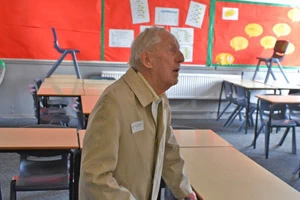

Gordon, Ali and Heather, visiting Malton School East Wing
- Malton Grammar School to Gordon -
on 9 March 2022.
At dinner, I thought maybe I’d see if I could do something. We used to employ Malayans, civilians, and one of them said that about four miles further down the road there was a cemetery where some soldiers were buried. I asked one of my mates if I could borrow his jeep – but he needed an officer’s permission. I chose my favourite officer to ask, and he was fine about borrowing the jeep. Now I needed a camera. Ginger Frith had one. I thought maybe we should take him with us – in case we couldn’t get the camera to work. The cemetery was a 30-acre field. Only a few yards from the wall there were some gravestones and we found the guy’s grave. It looked a bit tatty, so we borrowed some fresh flowers from the next grave to take the photos. I decided not to post the photos which I got developed in KL, so the poor mother saw the photographs when I got home three weeks later. The first thing she asked me was: ‘How much do I owe you?’. Of course the answer was ‘Nothing’.
I returned to England in September 1947. I got home on the Friday, and had a place at Leeds University to start on the Tuesday to study Honours Mathematics. It was a bit of a rush. There were seven of us in the first year. Three were ex-servicemen. We got an ex-service grant of £180/year. Lodgings were £3/week, and I had to buy books, clothes, etc., with the rest. I spent four years at Leeds; in the final year I wrote an MSc Thesis on Aerodynamics.
I was offered three jobs when I’d finished, all in the aircraft industry: Bristol Aeroplane Company, English Electric, and Avro. I went for an interview at Avro’s in 1951, and was interviewed by the chief aerodynamicist who was designing the Vulcan bomber and he showed me the drawings for it. He said you’d be working on the aerodynamic derivatives of this. But the Avro factory was in the middle of a sort of no-man’s land. I asked him where people lived, and he said about 20 miles south – so that put me off. Then I got an interview at the Bristol Aeroplane Company, and I liked the people. I took that job and worked on the Bloodhound, a ground-to-air guided missile, during the cold war. It was very successful, and we exported them to Sweden and South Africa, and of course the RAF took a lot. I worked on the mathematical electronics on one circuit for about 18 months, and realising it was very specialised, I thought I ought to move.
I applied to Blackburn’s in Brough, and as it happened I was interviewed by the Chief Designer of the Buccaneer, who had just come from Bristol (Barry Laight). He’d designed the Bristol freighter. He asked me what I thought about moving from Bristol to Brough, and I said ‘Well you should know if it’s a good idea or not’. His reply was that his job was not available. I made the move. My first job there was to design the Beverley, a big old freighter, but what I then went on to do was all the aerodynamics on the Buccaneer, from the very nose to the very tail. It was my job to check that the wing design was correct – the size and shape of the wings. I was sent to Farnborough and told to design the nose, given a Mach number. An old lady there was to give me the nose shape – and she told me that it was very similar to the Supermarine Swift. ‘Make it like that!’
They later sent me to see Küchemann at Farnborough, and I showed him all the diagrams. Dietrich Küchemann was the leading world authority on wing theory. Engines were built into the wings, giving two bulges. What they wanted to know was, would this make any difference or could we ignore them? He came up with the big answer, and that was that it wouldn't make enough difference to bother about.
Farnborough was full of Germans who were captured after the war, for example WJG Pinsker, who had worked at Peenemünde on the V2. He was at Bedford which was an extension of Farnborough, and had suites of computers which we didn’t.
In 1957, a lot of my friends emigrated to America and Canada; at the time Duncan Sandys was the Minister of Defence. It was clear that the aircraft industry was in decline. Blackburn’s never designed another aircraft – but did work in collaboration with others on the Airbus contract.
In 1958, Bradford opened a new College of Advanced Technology (CAT). They were advertising two jobs: Lecturer, and Principal Lecturer. As I had no teaching experience, I applied for the job of Lecturer. I got an interview, and the first thing they said was, ‘You’ve applied for the job of Principal Lecturer, haven’t you?’. I said ‘Yes!’ and got the job. The head of Mathematics there was Dr Freeman. He was very kind to me and gave me four hours off each week so I could do a PhD, which took me five years. My supervisor was Dr Price who was at Leeds. The title of my PhD was: ‘A general study of aircraft manoeuvres’, which was based on a previous paper by Brodetsky, who was the Head of Department in Leeds. He’d written a Royal Society paper in 1940 on that subject.
One of the staff at Bradford, Stuart Smethurst, knew everything about technical colleges. I mentioned to him that I quite fancied applying to work at York University which was just setting up – but maybe in its second year. He said no, you should apply now. The very first day, I was standing just behind Lord James, the founding Vice Chancellor, who was addressing the students. I thought I’d make a special effort to remember his first words. They were: ‘Can you hear me at the back?’ He later told the students, ‘You’re going to have to fix up your own societies’.
So I spent the next 27 years at York University, and then I retired!
I’m sure you have enough material already, but I thought you’d be interested to know that in my very first Mathematics lesson at Malton Mr. Brewin began by telling us that Mathematics was about three men - Al Gebra, ‘Arry Thmetic and Geo. Metry. How could I forget that?!
Links: Malton School | Malton Community Sports Centre | Malton and Norton Memories Facebook page | oldfern.co.uk
Copyright © 2013 Steve Fearnley